




What is the main function of a flat washer?
If you have ever assembled a piece of furniture, installed a shelf, or worked on a mechanical project, you have probably used a flat washer without giving it much thought. These thin, circular metal discs with a hole in the center seem almost too simple to matter — but they actually play a critical role in keeping your fasteners secure and your materials intact. If you are new to working with washers, you might have three important questions. First, do I really need to use a flat washer, or can I just skip it? Second, what happens if I use the wrong type or material? Third, how do I choose between stainless steel flat washers and carbon steel flat washers for my project? These are smart questions, and we are here to give you clear answers. In this guide, we will explain the main function of a flat washer, how it distributes load and protects surfaces, and why it matters more than you might think. We will also compare stainless steel flat washers vs carbon steel flat washers, discuss the key standards you need to know, and give you practical tips for selecting the right washer for your application. By the time you finish reading, you will understand exactly why these small components are essential for reliable, long-lasting fastening.
What is a flat washer and what does it do?
A washer is a thin, flat ring of material with a hole in the center, designed to be used with a fastener such as a screw, nut, or bolt. The most common shape is a flat disk with a concentric hole. But what is the main function of a flat washer? Let us break it down.
The primary function — Load distribution
The main purpose of a flat washer (also called a plain washer) is to distribute a fastener’s load over a larger surface area. When you tighten a bolt or screw, the force is concentrated directly under the bolt head or nut. Without a washer, this concentrated force can crush, indent, or deform the material you are fastening — especially if that material is softer than the fastener itself.
By placing a flat washer between the fastener head and the work surface, you spread that force across a wider area. This reduces the stress on the material, prevents surface damage, and creates a more secure connection. In structural bolting systems, using a flat washer helps maintain a stable friction coefficient between the nut and the connection surface, which is critical for achieving the correct preload.
Surface protection
Another key function of a flat washer is protecting the surface of the parts being fastened. When bolts need to be frequently assembled or disassembled, direct contact between the bolt head or nut and the workpiece can cause scratches, surface deformation, or coating damage. A flat washer acts as a barrier, absorbing the compression forces of the bolt and preventing the fastener head from gouging or marring the material underneath.
Additional uses — Spacers and covering oversized holes
Flat washers are also commonly used as spacers in industrial and domestic applications. They can help position components at the correct distance from each other. Additionally, when bolt holes are designed with larger diameters or elongated slots to allow for adjustment during assembly, flat washers or thickened flat washers are often used to cover oversized holes and ensure proper load distribution.
Stainless steel vs carbon steel flat washers — Which should you choose?
Now that you understand the main function of a flat washer, let us talk about material selection. The two most common materials are stainless steel flat washers and carbon steel flat washers, and each has its own strengths and weaknesses.
|
Feature |
Stainless Steel Flat Washers |
Carbon Steel Flat Washers |
|---|---|---|
|
Corrosion Resistance |
Excellent — ideal for saltwater, chemicals, and outdoor use |
Moderate to poor — requires coating (e.g., zinc) to resist rust |
|
Strength |
High tensile strength and temperature tolerance |
Very high load-bearing capacity |
|
Cost |
Higher |
More affordable |
|
Best Applications |
Marine equipment, food processing, outdoor/industrial use, corrosive environments |
Automotive, construction, indoor applications, heavy-duty dry environments |
|
Common Standards |
ASME B18.21.1, ISO 7089 |
ASME B18.21.1, DIN 125A |
|
Drawbacks |
Higher cost than carbon steel |
Prone to corrosion in humid or wet environments without coating |
Stainless steel flat washers — The corrosion-resistant choice
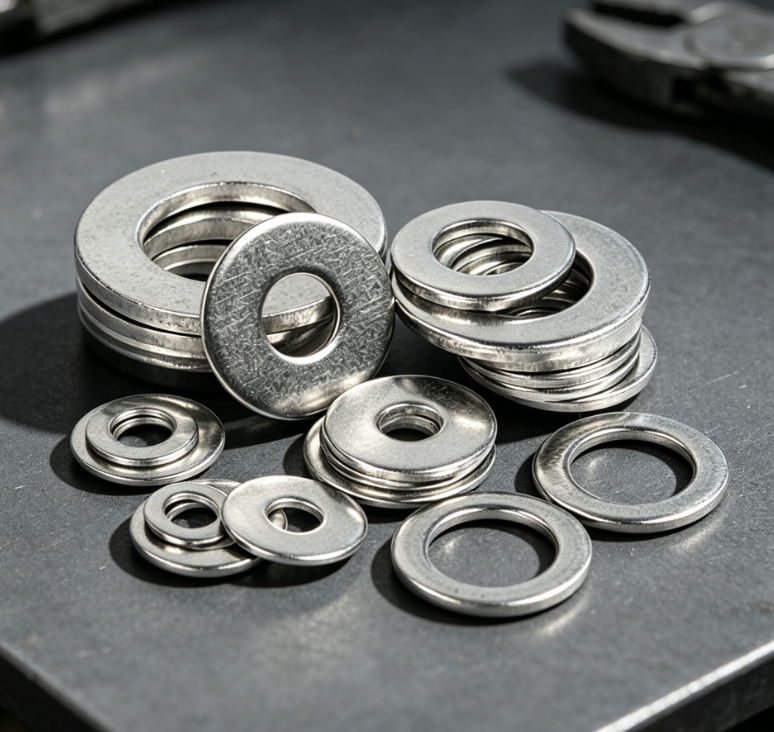
Stainless steel flat washers are the go-to choice for applications where corrosion resistance is a priority. They contain chromium, which forms a passive oxide layer that protects the metal from rust and chemical attack. This makes them ideal for outdoor use, marine environments, food processing equipment, and any application where moisture or chemicals are present. Common grades include 304 (A2) and 316 (A4) stainless steel, with 316 offering superior protection against saltwater and chlorides. Stainless steel flat washers are covered by standards such as ASME B18.21.1 and ISO 7089.
Carbon steel flat washers — The cost-effective workhorse

Carbon steel flat washers are the most common type of flat washer, typically made from Q235, 65Mn, and other high-quality carbon steels. They offer excellent strength and durability at a lower cost than stainless steel. However, carbon steel is prone to corrosion when exposed to moisture, so these washers usually require a coating — such as zinc plating or galvanization — to resist rust. Carbon steel flat washers are widely used in automotive, construction, and indoor applications where corrosion is not a major concern.
Key standards and specifications for flat washers
When sourcing flat washers from flat washer manufacturers or flat washer suppliers, it is important to understand the relevant standards. In the United States, the primary dimensional standard for flat washers is ASME B18.21.1. Under this standard, there are two types: Type A and Type B. Type A has two series sizes — narrow and wide — while Type B has three series sizes: narrow, regular, and wide. The narrow series has smaller thickness and outside diameter compared to the wide series, with regular falling in between.
For metric flat washers, common standards include ISO 7089 and DIN 125. These standards specify parameters like inner diameter, outer diameter, and thickness for various sizes. When ordering from flat washer manufacturers, always verify which standard applies to your application.
How to choose the right flat washer for your application
Selecting the right flat washer comes down to four key factors:
1.Environmental conditions — If your application involves moisture, saltwater, or chemicals, choose stainless steel flat washers. For dry, indoor use, carbon steel flat washers with a protective coating are a cost-effective option.
2.Load requirements — For high-stress applications, both stainless steel and carbon steel offer excellent strength. However, carbon steel flat washers are often preferred for heavy-duty structural applications due to their very high load-bearing capacity.
3.Budget constraints — If cost is your primary concern and the environment is dry, carbon steel flat washers offer the best value. For long-term investment in corrosive environments, stainless steel flat washers are worth the higher upfront cost.
4.Standards compliance — Ensure your flat washer suppliers provide products that meet the relevant standards for your industry, such as ASME B18.21.1, ISO 7089, or DIN 125.
Contact Us
Not sure which flat washer is right for your application? Our team works with leading flat washer manufacturers and flat washer suppliers to source high-quality stainless steel flat washers and carbon steel flat washers for any industry. Whether you need flat washer prices for a large order or assistance with technical specifications, we are here to help. Reach out today for a consultation or a quote tailored to your needs.
FAQ
Q1: What is the difference between a flat washer and a lock washer?
A flat washer (or plain washer) is designed to distribute load and protect surfaces from damage. A lock washer, on the other hand, is designed to prevent fasteners from loosening due to vibration — it "locks" the nut or bolt in place by providing friction or a mechanical bite. They serve different purposes and are often used together in bolted assemblies.
Q2: Can I reuse a flat washer?
Yes, flat washers can generally be reused as long as they are not deformed, cracked, or significantly worn. However, if the washer shows signs of damage or has been subjected to extreme loads that caused it to embed into the material, it should be replaced. For critical applications, it is always best to use new washers to ensure consistent performance.
Q3: What is the difference between SAE and USS flat washers?
SAE (Society of Automotive Engineers) flat washers are typically smaller and thinner than USS (United States Standard) flat washers, with a smaller inside diameter. USS washers are larger and thicker, providing a wider load-bearing surface. The choice between them depends on the specific requirements of your application, including bolt size and load requirements.